
CARE FOR THE ENVIRONMENT
Not only do we care for people, we also care for the environment around us.
At Mapa Professional, we are fully aware that respecting the environment is part of our responsibility.
Our Commitments:
Reducing our environmental footprint

Manufacturing
As gloves manufacturers, we closely monitor and commit to reduce the environmental footprint of our factories. They are all ISO 14001 certified (environmental management).
Sourcing
We are determined to select the most responsible raw materials possible, with a preference to raw materials and packaging sourced locally (close to our factories).
Footprint measuring
As carbon footprint has become a key criterion in PPE selection, Mapa Professional is committed to providing transparent carbon footprint information by measuring and sharing the results of Life Cycle Assessments (LCAs) for its products.
Systematizing eco-design approach
Product
We run a Life Cycle Assestment of our product & packaging in development in order to understand where we are and how reducing our impact.
We do our best to reduce our main environmental impacts at every step of our products Lice Cycle while guaranteeing a maximum product lifetime and without compromising the performance of our products.
More than 70% of our cut -resistant gloves are washable to guarantee an extended lifespan and to reduce the amount of waste generated by our users.
Packaging
Our packaging (cardboard or LDPE plastic) are designed to be recyclable. Its recyclability depends on the recycling system available locally.
In BtoB, there's no national organized collect scheme in most European countries, meaning it's up to each end user to organize such packaging recycling with its waste management partner.
We strive to reduce our plastic packaging footprint with :
- Reduction program (suppression or volume optimization of consumer packaging) : 10 tons plastic saved in 2024.
- Substitution of virgin material by recycled one (e.g. 30% RLDPE) for 100% plastic grouping bags since May 2023 & for all our primary packaging for 2026
What is a Life Cycle Assessment (LCA) ?
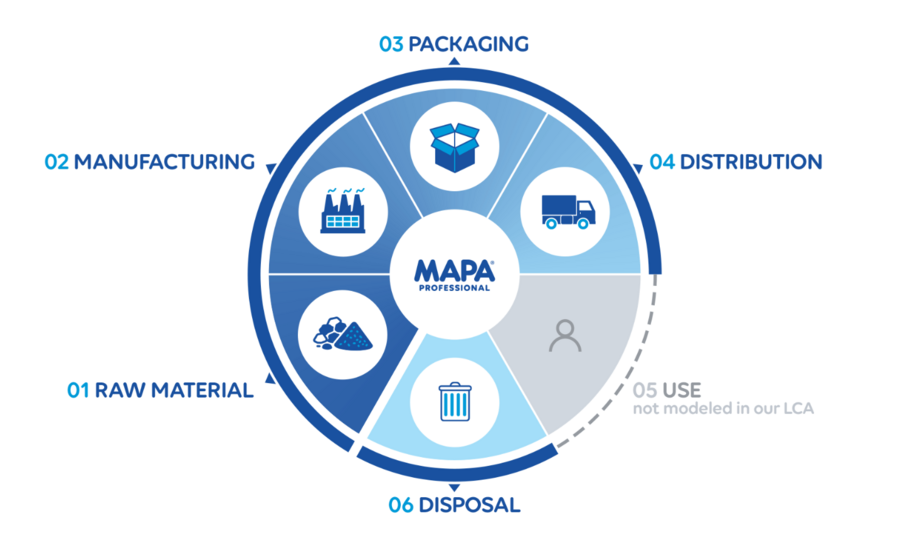
The Life Cycle Assessment is a method used to calculate the environmental impact of a product at every stage of its lifecycle and through different scopes :
Cradle-to-Gate: This measure evaluates the environmental impact from the extraction of raw materials to the dispatch of finished, packaged products from the factory gate.
Cradle-to-Grave: This measure evaluates the environmental impact from the extraction of raw materials through to the end-of-life of the finished product, including the use phase.
As the environmental impact during use can vary significantly across industries, Mapa Professional has chosen to provide a Cradle-to-Grave score excluding the use phase
Our Approach
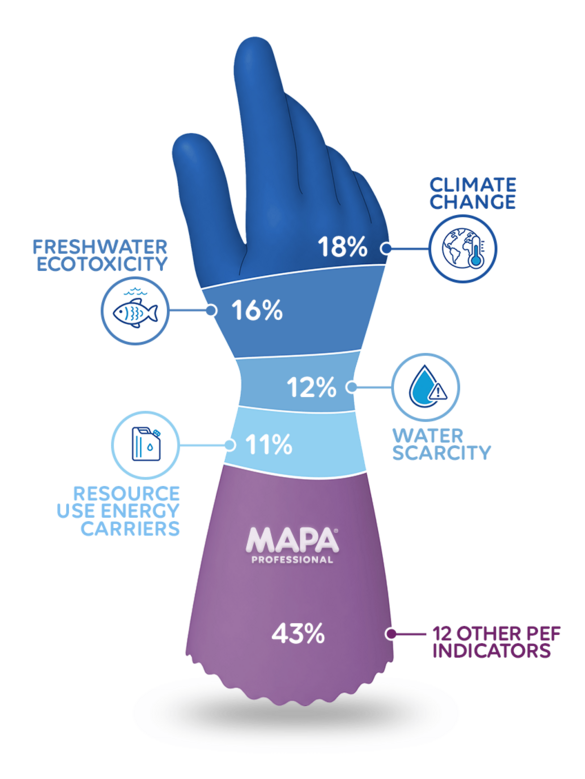
Our Life Cycle Assessment (LCA) is conducted in accordance with the European Product Environmental Footprint (PEF) methodology, developed by the European Commission to ensure consistent and comparable environmental assessments across products.
This approach is fully compatible with the principles and framework of the ISO 14040 and ISO 14044 standards, which define the internationally recognized benchmarks for life cycle assessment.
This methodology helps us measuring the environmental footprint of our products across multiple indicators and pointing out the most impactful stages of a product’s life cycle.
Mapa Professional uses the Askor software developed by EVEA to perform the Life Cycle Assessments of its gloves and calculate their carbon footprint.
To contribute to a collective effort to harmonize Life Cycle Assessments in the PPE industry, Mapa Professional has partnered with EDONI, a collaborative initiative bringing together key PPE industry stakeholders to develop common methodologies and improve the consistency and quality of environmental data.
Our Target
Mapa Professional aims to facilitate and to support a more informed glove selection by improving the transparency of environmental data while harmonizing measurement methodologies with industry key players.
How to find our gloves Life Cycle Assessments ?

To ensure we provide the most accurate and reliable data, our assessment covers all life cycle stages except the use phase. The use phase has not been modelled because customer usage patterns vary significantly depending on the application and operating practices, making representative modelling unreliable. This approach ensures that our carbon footprint results are based on robust and controlled data.
Our carbon footprint results are available on each product page and in each product data sheet, which also indicate the data extraction date and the methodology used.
See example for our Krytech 574.
You can contact our local teams for further informations regarding the Life Cycle Assesments of our products.
FAQ
What does the PEF Methodology measure exactly?
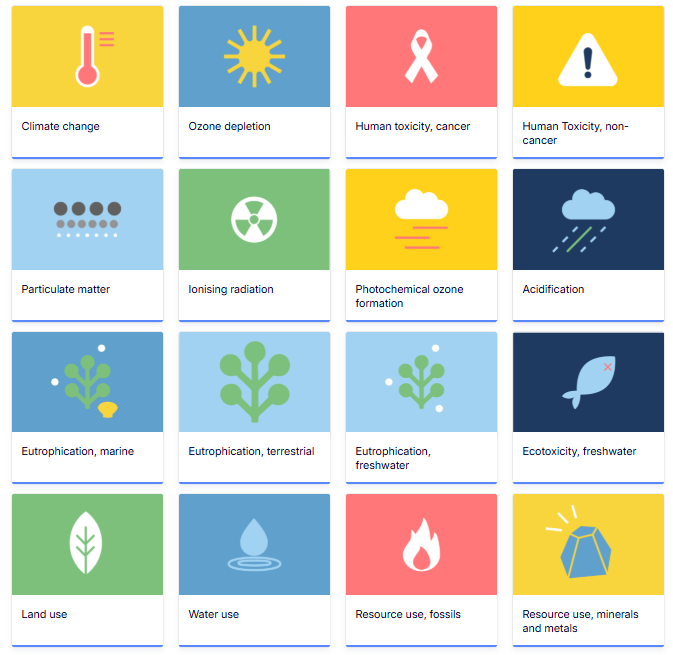
The Product Environmental Footprint (PEF) methodology uses 16 environmental impact categories such as climate change, water use or land use, Each impact category is assigned a specific weighting factor to calculate a single environmental score, expressed in micro-points (µPt), based on the annual environmental impact of an average European citizen. (example : Climate change is pondered by 21%).
This approach follows the ISO 14040 & ISO 14044 standards and goes beyond a simple carbon footprint by considering the product's overall environmental impact.
Learn more about the 16 environmental impact categories with the European Commission.
What is the difference between Cradle-to-Gate and Cradle-to-Grave calculations?
The Cradle-to-Gate score only takes in consideration the environmental impact from raw material extraction until the product leaves the factory’s gate whereas the Cradle-to-Grave score acknowledges the entire life cycle of the product until its disposal. To ensure we provide the most accurate and reliable data, our assessment covers all life cycle stages except the use phase. The use phase has not been modelled because customer usage patterns vary significantly depending on the application and operating practices, making representative modelling unreliable. This approach ensures that our carbon footprint results are based on robust and controlled data.
Where can I find the Carbon footprint of a specific product?
A Life Cycle Assessment (LCA) is performed for each product, and the resulting carbon footprint is available on our product pages and in our product data sheets. For further information, please contact your local Mapa Professional team.
Does a lower environmental footprint mean lower protection and performance?
No, the environmental footprint and protection performance are two distinctive criteria. Mapa Professional is committed to protecting hand around the world and across industries while taking the gloves environmental impact in consideration.
Our gloves follow specific standards and never compromises the safety and performance.
How to use carbon footprint data in my purchasing decision?
Carbon footprint data, calculated through Life Cycle Assessment (LCA), helps you consider the climate impact of a product as part of your procurement process.. This allows more transparency and helps identify lower-carbon solutions fitted to your requirements to strengthen your company’s CSR and sustainability objectives and reporting. Please note that carbon footprint should not be used as the sole purchasing criterion. Safety, regulatory compliance, performance, and user comfort should always take precedence. When comparing products that offer equivalent levels of protection and performance, carbon footprint data can help identify the lower-impact solution
Can I compare Mapa Professional's carbon footprint results with those of other companies?
Not at this stage. Although Mapa Professional actively supports the harmonization of Life Cycle Assessment (LCA) methodologies through its partnership with EDONI, the PPE industry has not yet agreed on a common calculation methodology.
As a result, carbon footprint results from different manufacturers are not necessarily directly comparable, as they may be based on different system boundaries, modelling assumptions, data sources, allocation rules and calculation methods. Until a harmonized industry methodology is established, comparisons between companies should therefore be made with caution.
However, carbon footprint results calculated using the same methodology can be used to compare products within the same product category and help identify lower-impact solutions with equivalent safety, performance and comfort.
Get in touch
If you would like to ask us a commercial question about our products or if you would like to have more technical information about our gloves and their use, please fill out one of the forms proposed below.
Standards
All standardsDocumentation

Mapa Professional 2026 Catalog
Online readingEnglish - 2026 edition