












Introducing our new ADVANCED GRIP technology
Our UltraNitril 358 and 458 combine chemical protection and enhanced grip.

Discover our NEW chemical glove selection tool !
4 steps to find the glove that meets your needs
How do you choose the right protective glove size? Find out how to measure your hand, identify the right size and choose your Mapa Professional gloves by material, thickness and length.
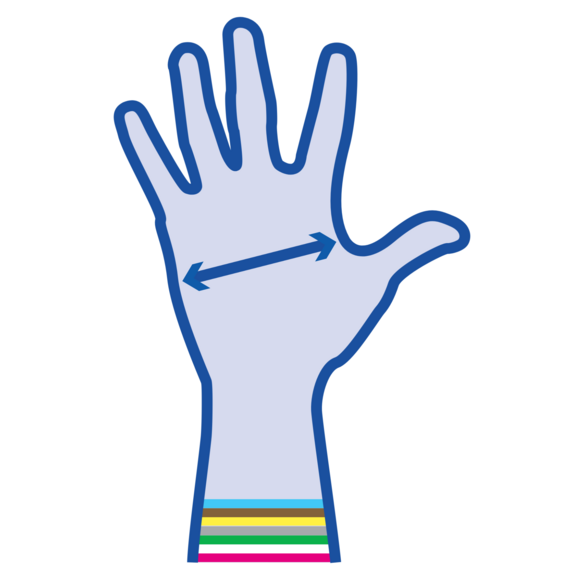
At Mapa Professional, gloves come in sizes 5 to 11, i.e. XXS to XXL (a different correspondence applies to the disposable range). Size is determined from one main measurement: hand circumference (measured in centimetres at knuckle level, thumb excluded). For example, a hand circumference of 20 to 21 cm corresponds to a size 8 (M for reusable references; L for the disposable range).
However, measurement is not everything. The reference measurements in the EN ISO 21420 standard do not consider other parameters that can influence the choice of size, such as finger length or width. Depending on the material, thickness or length of wear, two operators with the same hand circumference will not necessarily wear the same glove size.
You will need a soft tape measure. Failing that, a piece of string will do.
If you fall exactly between two sizes, the general rule is to take the larger size for thick references and the exact size for thinner ones. The section on materials explains why.
Hand circumference | Numeric size | Letter size - Reusable glove | Letter size - Disposable glove |
|---|---|---|---|
12,7 cm | 5 | XXS | / |
15,2 cm | 6 | XS | S |
17,8 cm | 7 | S | M |
20,3 cm | 8 | M | L |
22,9 cm | 9 | L | XL |
25,4 cm | 10 | XL | XXL |
27,9 cm | 11 | XXL | XXXL |
Some hand shapes make choosing a size more difficult, for example wide, short hands, narrow, long hands, or particularly long fingers. In this case, we recommend trying on several sizes to find the best fit.
In all cases, the right glove size should be confirmed by trying the glove on. An operator who finds their glove comfortable will keep it on all day, and that is precisely where real protection is decided: a glove taken off at 10 a.m. no longer protects for the rest of the day.
The performance levels shown on a technical data sheet are obtained in an accredited laboratory and do not vary with the size worn. What size changes is what happens on the hand: comfort, flexibility and fatigue, properties that are not standardised but that directly determine whether the wearer accepts the glove and how effective it is day to day.
A glove that is too large lacks support and may slip. Grip becomes less effective, the reinforced areas no longer sit over the areas they are meant to cover, and the glove is more likely to be pulled off when handling rotating machinery. Of the two cases, this is the more dangerous.
A glove that is too small compresses the fingers, restricts blood circulation and leads to a loss of comfort, hand fatigue and even musculoskeletal disorders (MSDs).
The EN ISO 21420 dexterity test is carried out with the glove on. Fit is in fact a key criterion for the level achieved. The glove itself is also assessed during the test: gauge, type of coating, etc. If the glove is fitted with an anti-impact pad, it must be correctly positioned on the hand to meet the requirements of EN 388.
Anatomical gloves are designed separately for the right and left hand. They follow the natural curve of the fingers at rest, which reduces fatigue during prolonged wear and improves grip. They are found mainly in reusable ranges.
Ambidextrous gloves suit both hands. A symmetrical cut is possible without loss of comfort in disposable ranges and on sleeves. This can also simplify stock management, a logistical advantage that is far from negligible depending on the organisation.
Mapa Professional gloves are between 0.07 and 2.5 mm thick, depending on the range. The thicker a glove, the less dexterity it allows, and the more a size that is too tight becomes a penalty. On thick ranges, it is better to have a slightly comfortable size than one fitted to the millimeter.
Material | Indicative thickness | Behaviour with regard to size |
|---|---|---|
0,1 – 1 mm | Very elastic, tolerant | |
0,07 – 0,6 mm | Not very elastic, little tolerance | |
0,55 – 0,95 mm | Moderate stiffness | |
Coated textile support | Variable | Adaptive comfort |
Glove length has nothing to do with hand size. It is a coverage choice: Mapa Professional ranges run from 22 to 62.5 cm, and the longer the glove, the more of the arm it protects. This is decisive for chemical splashes, immersion, or handling hot parts.
Cuff type | Characteristics | Main advantage |
|---|---|---|
Safety cuff | Rigid | Wrist protection, quick glove removal and good ventilation of the hand. Perfect for jobs with a risk of entanglement. |
Knitted cuff | Flexible, fits the wrist | Provides a good fit for the hand and protects the wrist. |
Straight cuff | Clean cut, no elasticity | Improved hand ventilation. |
Rolled cuff | Reinforced edge, prevents run-off | Reduces the risk of tearing when doffing gloves. |
Scalloped cuff | Light, flexible cut | Longer service life for the glove. |
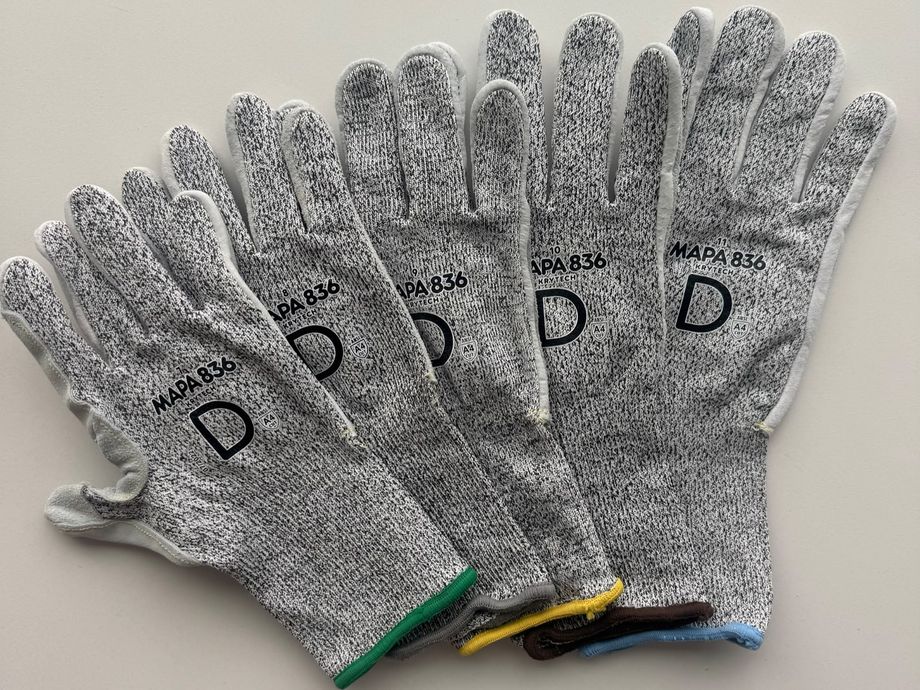
On the mechanical range, each colour of wrist trim corresponds to a size, which makes it possible to identify a size quickly without reading the label: 5 pink, 6 white, 7 green, 8 grey, 9 yellow, 10 brown, 11 blue.
For a buyer or an HSE manager, size is not a matter of comfort detail: it is a line in the prevention policy. A badly calibrated order produces returns, gloves worn by default in the wrong size, and risks covered on paper only. All of these discrepancies show up in the risk assessment.
Survey. Measure the hand circumference of each employee or collect declarations via an internal form.
Build the distribution. In most industrial environments, the distribution is concentrated on sizes 7, 8 and 9. Stock should follow this reality rather than an even split.
Plan for the smallest and largest sizes. A minimum stock in sizes 5 and 11 prevents shortages for rare profiles, who are also the ones for whom improvisation is the riskiest.
Trace. Record the selected PPE with its size in the risk assessment. In the event of an inspection or accident, traceability of the allocation is part of the file.
Wrap a soft tape measure around the palm of your dominant hand, at knuckle level and excluding the thumb, with the hand slightly bent. The value in centimetres gives the size directly: 20 to 21 cm corresponds to a size 8 (M) at Mapa Professional.
A palm circumference of 22 cm corresponds to a size 9, i.e. an L. The size 9 range runs from 22 to 23 cm. At 22 cm, you are at the bottom of the range: on a thin range, check whether a size 8 might fit better.
Size 9 corresponds to an L for a reusable glove and an XL for a disposable glove. For reusable gloves, the Mapa Professional system matches numeric sizes 5 to 11 with letter sizes XXS to XXL: 5 = XXS, 6 = XS, 7 = S, 8 = M, 9 = L, 10 = XL, 11 = XXL, while disposable gloves are offered from size 6 (S) to 11 (XXXL).
Not systematically. First follow the size chart. If your measurement falls between two sizes, take the larger size on a thick range, where a size that is too tight sharply reduces dexterity and comfort during prolonged wear.
Measure your dominant hand, generally the more developed one. If there is a clear difference between the two hands, use the larger measurement: a glove that is slightly loose on one hand is preferable to a glove that squeezes the other.
Yes. It slides of the hand, reduces gripping precision and shifts the reinforced areas away from the areas to be protected.
Protective glove sizes are based on the reference values of the EN ISO 21420 standard, which sets the general requirements applicable to all protective gloves. However, these reference measurements do not consider other parameters that can influence the choice of size, such as finger length or width. The exact ranges may vary slightly from one manufacturer to another depending on the cut.
Measure the hand circumference of each employee, build the team's actual distribution, adjust stock to the dominant sizes (often 7, 8 and 9) and keep a reserve in XXS and XXL. Then record the allocation in the risk assessment.
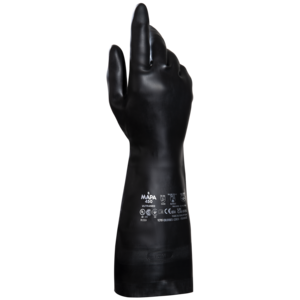
Extremely supple with freedom of movement for standard chemical protection
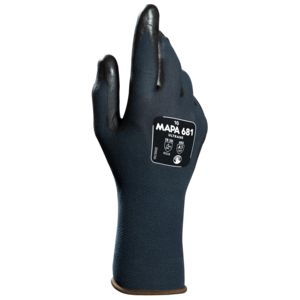
Comfort, suppleness and high dexterity thanks to its 18 gauge. Touchscreen ability.
If you would like to ask us a commercial question about our products or if you would like to have more technical information about our gloves and their use, please fill out one of the forms proposed below.

Our UltraNitril 358 and 458 combine chemical protection and enhanced grip.
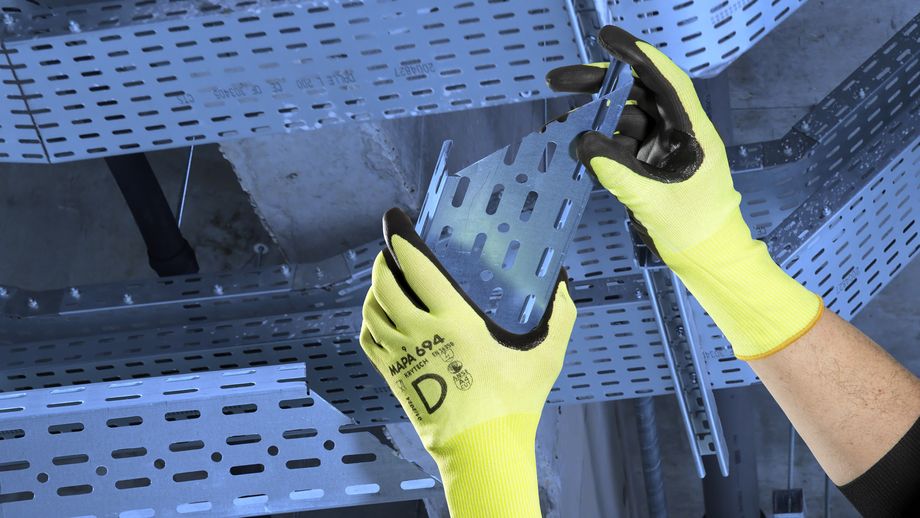
Explore our Gauge 18 ultra-comfort gloves, with or without cut protection, designed to enhance safety and dexterity in mechanical environments.
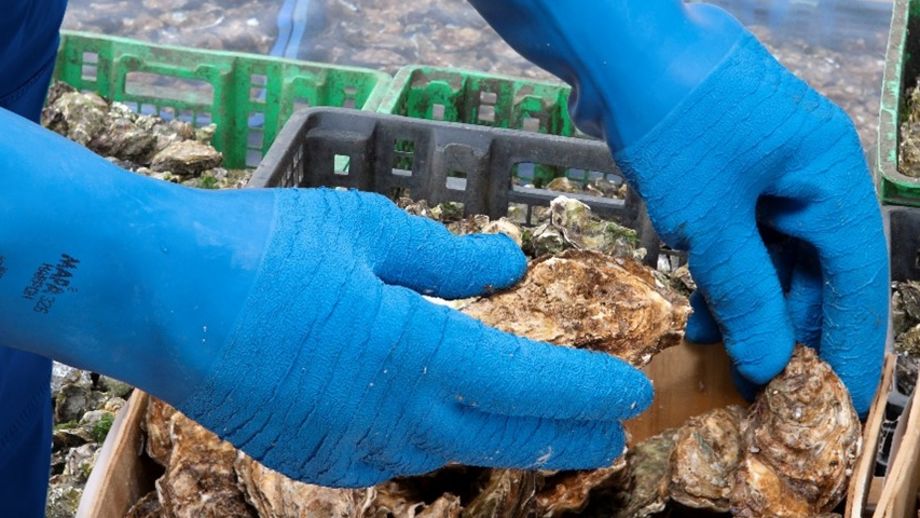
Mapa Professional presents a complete glove range with food certification to meet several tasks in the food industry: production, processing, distribution and catering, among others.